
A FIELD-DAY PLAYBOOK
Six teams. Three stations. No queue at the clipboard.
A small field day is a movement problem before it is a scoring problem. Here is a complete three-round rotation, a scoring convention, and a correction routine for thirty hypothetical participants.
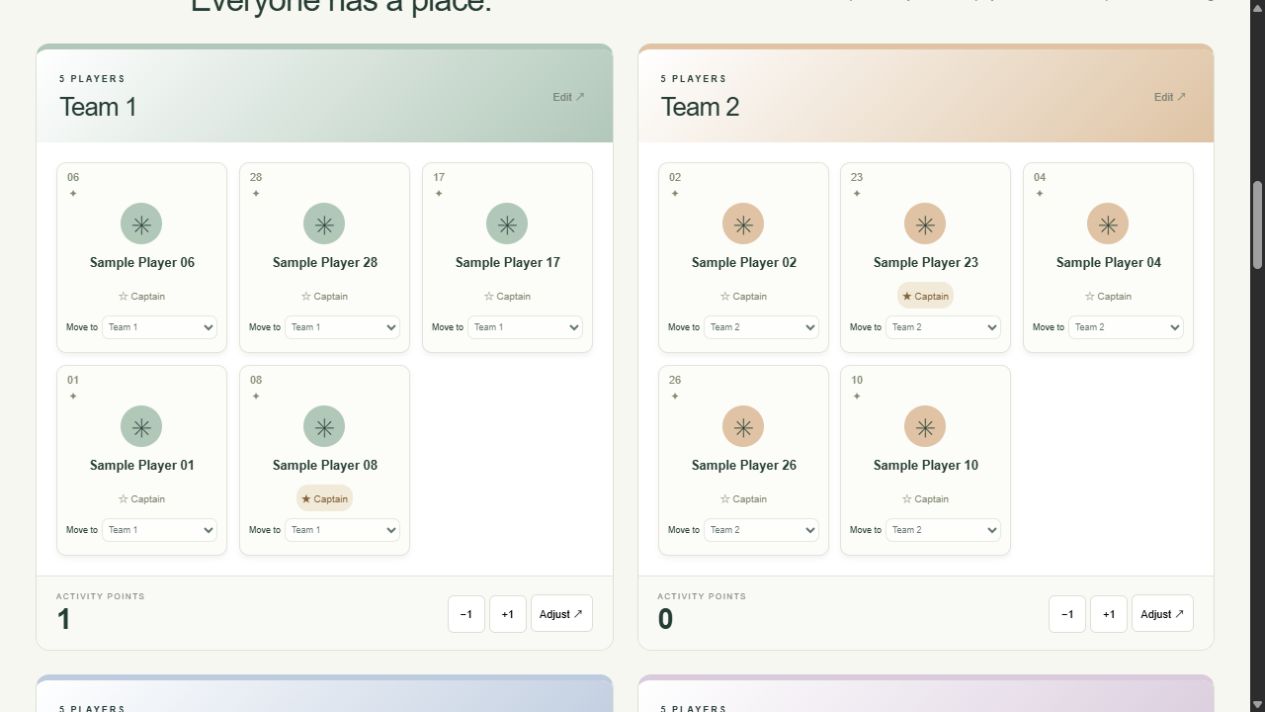
A fictional event design, not a report of a live sports day. Station suitability, access arrangements, supervision, weather decisions, and equipment checks belong to the responsible adults running the event.
The awkward part of a six-team activity is often the minute between rounds. One team heads for the station it has already visited. Two captains ask whether “12 points” means twelve successful attempts or twelve league points. Someone wins the hand duel and assumes that win belongs on the scoreboard. Those are three different coordination failures. A larger wheel will not resolve them.
Start with thirty participants, six teams of five, and three stations that can each host two teams. Team size is balanced by headcount, not by ability or access needs. Make any necessary adjustments before scoring starts: Calling You fixes team membership once points or played matches exist so that recorded results remain attached to the lineup that earned them.
Before the first round: rename teams A through F, print the rotation, agree one scoring vocabulary, and nominate one adult to enter the final numbers.
What the draw does: assigns people to teams. It does not decide which activities are appropriate or how a particular participant should be supported.
Check the shape of your event first
This rotation assumes exactly six teams and three stations, each ready for two teams at once. A single-lane station that can host only one team breaks the plan: one team waits while another gets practice time. Duplicate that station, create a clearly defined parallel task, or redesign the rotation before distributing the sheet.
If fewer than thirty people arrive, six teams may have different sizes. Decide whether stations use equal attempts, equal time, or a per-person measure, and explain that choice before play. Equal headcounts are only one possible constraint.
The rotation is the main piece of equipment
| Round | Station 1 | Station 2 | Station 3 |
|---|---|---|---|
| 1 | A vs B | C vs D | E vs F |
| 2 | C vs E | A vs F | B vs D |
| 3 | D vs F | B vs E | A vs C |
Read the schedule horizontally to run a round. Read it by team to check movement. Team A goes 1 → 2 → 3; B goes 1 → 3 → 2; C goes 2 → 1 → 3. Each team appears once per round, visits all three stations, and meets three different opponents. There are nine encounters, not a full six-team round robin, which would require fifteen.
That distinction matters inside the app. Generate round-robin fixtures creates the fifteen-match format; it does not create this station rotation. Use the downloadable run sheet for the three-round event. Enter station awards as Activity points, or deliberately choose match results for a league. Do not mix the two methods halfway through because both display a number called points.
Choose a station that can be explained in one sentence
For illustration, Station 1 could count accurate placements, Station 2 could time a cooperative puzzle, and Station 3 could count successful team sequences. These are planning placeholders, not prescribed physical activities. The leader must define what counts, what equipment or adaptation is allowed, and how a team knows an attempt has ended. Every participant should have a meaningful role that fits the event.
A workable timing envelope is five minutes of briefing, three eight-minute rounds, two three-minute transitions, and five minutes of closing: forty minutes in total. The transitions are real time, not spare minutes to borrow silently. If a round runs long, shorten a planned round consistently or explain a revised schedule to every station rather than letting one team receive extra attempts.
One scoreboard, one interpretation
For this example, award three activity points for winning a station encounter, one each for a tie, and zero for a loss. Raw observations stay on the station sheet: accurate placements, seconds, or completed sequences. The station leader translates them into the agreed award. This avoids adding seconds directly to successful placements, which would be numerically possible and conceptually meaningless.
| Station observation | Award entered in Calling You | Reason |
|---|---|---|
| A: 12 accurate placements; B: 9 | A +3; B no adjustment | Round 1 / Station 1 |
| C and E record equal accurate placements | C +1; E +1 | Round 2 / Station 1 / tie |
Use Adjust for a three-point award; the +1 button is useful for one-point ties or small corrections. Enter the round and station as the reason so that a teacher can trace the number later. A team with zero points needs no zero-value ledger entry. Do not also save the encounter as a league win unless you intentionally want a separate second competition table.
If you prefer league standings, save each encounter as a match and use the configured win/draw/loss rules. The example above uses activity points because the rotation is organized around stations. Either convention can work. The important choice is to name it before participants begin.
Use the hand duel for a decision it can actually make
At a station where order matters, choose the two team names, set one winning round or a best-of series, and start the five-second duel. The two animated hands are random outputs generated on this device, not live gestures submitted by players. A tie needs a replay. The result decides who starts; it adds no activity points or match win.
Preview the countdown sound before the event and keep a visible result available. A loud field may make the spoken announcement hard to hear, while a quiet space may make the default volume excessive. A sound check is more useful than discovering the device is muted during a transition.
Fix the result while the station sheet is still nearby
Suppose Station 2 reports A +3, then notices that F actually won. If that +3 is the latest ledger entry, Undo latest adjustment removes it. If other entries followed, make a clearly explained A −3 correction and an F +3 award. Do not remove an unrelated latest adjustment just to reach an older mistake. A negative adjustment is visible, so write the reason in plain language.
For a saved match, open its existing fixture and edit the result instead of adding a second match. Editing replaces that match’s contribution to standings. These correction paths differ because a point ledger is a list of adjustments, while a match is one editable result.
Before closing, ask station leaders to read out their awards and compare the ledger. Export CSV for the event record and a separate outdoor JSON backup for recovery. A classroom backup does not include outdoor scores. Finish with a shared activity reflection, not a claim that the scoreboard measures everyone’s contribution.
Print the movement, not the software manual
The run sheet includes the verified rotation, timing envelope, station observation blanks, point-award blanks, and a closing reconciliation checklist.
Download the station run sheet ↓