
A SMALL FAIRNESS LAB
A repeat can be fair. An unheard voice can still matter.
Equal probability, complete turn coverage, and evidence of understanding are different goals. A small calculation and a classroom decision map make the differences visible.
An original explanation with mathematical examples and hypothetical classroom decisions. The calculator describes a model; it is not a test of a teacher, a student, or the quality of a browser’s random generator.
Avery appears twice in a short discussion. Someone says the wheel is unfair. There are at least two possible meanings: Avery had a larger chance than classmates, or the class wanted everyone to get a turn before anyone repeated. The first is a question about probabilities. The second is a rule the teacher could choose. They cannot be resolved by looking at two results alone.
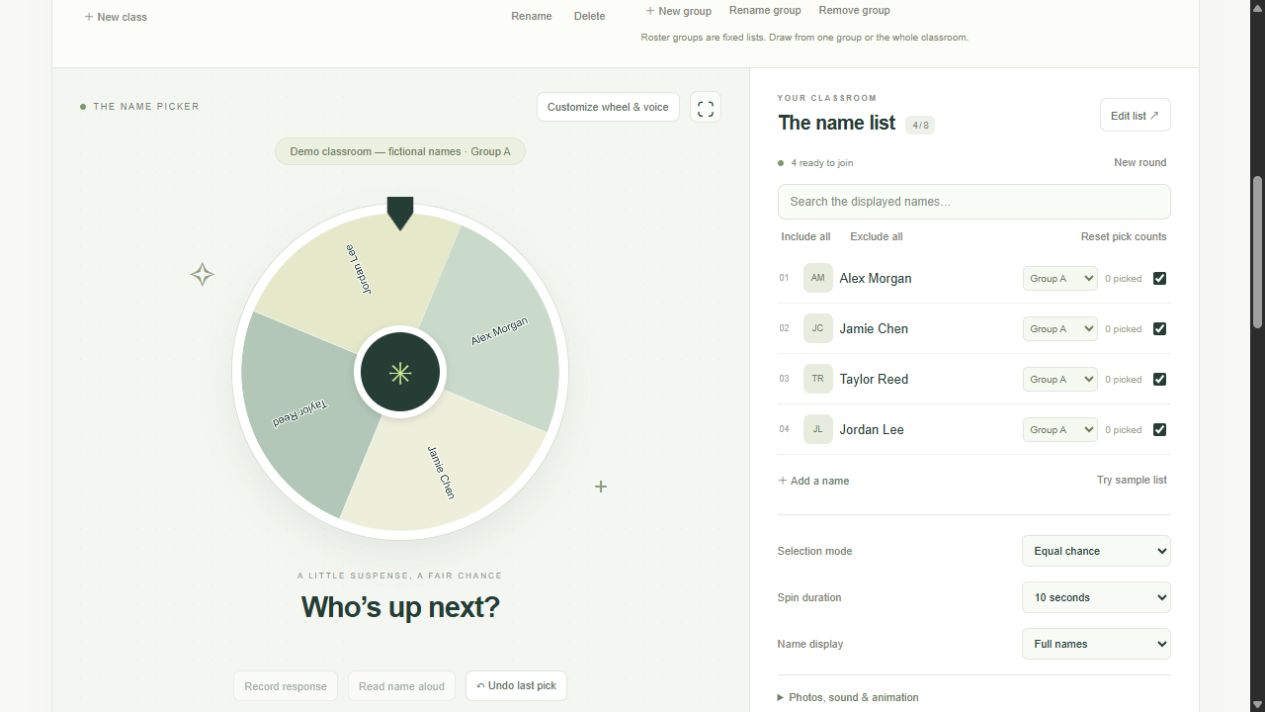
Equal chance redraws from the same included pool. No-repeat draw removes a selected person from the current round. Least-picked first chooses among eligible students with the lowest saved selection count. These rules should sound different when explained aloud, because they are doing different things.
Try the same class under two promises
What should repeats look like?
Set a fixed eligible pool and a number of independent equal-chance draws. Nothing is drawn from your classroom roster.
Model: a fixed pool, independent draws, equal probability, and replacement after each draw. Rounded results are theoretical averages and probabilities, not guarantees for one class.
For thirty students and ten equal-chance draws, an individual student’s chance of not appearing is (29/30) raised to the tenth power. That is about 71.2%. Missing this short sample is therefore unsurprising. It tells you very little about the student and does not by itself show a defect in the tool.
The expected number of distinct selected students is n × [1 − (1 − 1/n)k], where n is the fixed eligible pool and k is the number of draws. “Expected” is an average over many imagined repetitions, not a promise that a fractional person will appear. The probability of at least one repeat is one minus the product 1 × (n−1)/n × (n−2)/n and so on for k factors. Once k exceeds n, a repeat is certain in this replacement model.
PREDICT FIRST, THEN CALCULATE
Four students. Four independent draws. Will all four appear?
Ask for a prediction before entering 4 and 4 in the calculator. There are 4 × 4 × 4 × 4 = 256 equally likely ordered outcomes. Only 4 × 3 × 2 × 1 = 24 contain everyone exactly once. That is a 9.375% chance of complete coverage, or a 90.625% chance of at least one repeat.
Now compare a no-repeat round: four successful draws cover all four included people. The surprise comes from changing the rule, not from changing the animation. This small example can be checked by listing outcomes; it does not require believing a large simulation.
Change the promise when coverage is the goal
Say “Every included person gets one selection before the round restarts” and use No-repeat draw. With thirty eligible people, thirty successful selections cover thirty distinct people. The round then has no available name until you choose New round or change eligibility. That is a different promise from equal chance on every independent draw.
It is also a time commitment. Thirty ten-second animations alone take five minutes. Add even twenty seconds of speaking per person and the selection-and-answer routine reaches fifteen minutes, before transitions or follow-up questions. If the lesson cannot afford that, consider small-group rehearsal and fewer public reports, or a written response from everyone. Do not solve a teaching-time problem by claiming that six drawn names represent thirty individual answers.
| Your question | A suitable starting point | The limit to remember |
|---|---|---|
| Who gets this independent turn? | Equal chance | Repeats and short-term omissions are normal. |
| Who has not had a selection in this round? | No-repeat draw | A selection is not proof of a spoken response. |
| Who has fewer saved random selections? | Least-picked first | Saved counts can span different attendance and lesson histories. |
| Whose response evidence have I actually recorded today? | Participation check | It reads retained records; missing entries and voluntary answers need context. |
A counter is not a biography
Imagine Alex has one saved pick, Jamie has four, and Taylor has none. Least-picked priority favors Taylor while all three are eligible. It cannot know whether Taylor joined recently, was absent earlier, spoke voluntarily without an entry, or needs an agreed alternative way to respond. The count is accurate about what was saved and incomplete about the person.
Before comparing totals, decide the period you mean. Lifetime pick counts are useful for continuity, but they are not automatically today’s lesson. Participation check filters the retained recent records by local day or a short window. It does not reset saved counts. Clearing history cannot reconstruct a fresh past: the evidence is gone, while cumulative totals may remain.
Current group membership is another boundary. If Jamie moves from Group A to Group B, a review by current roster group shows Jamie in B even for an older record. That is useful for planning the next opportunity, but it is not a historical attendance register. The review tells you which current students have matching retained records, not who was physically in an old group.
Use the orange state to repair your notes
An orange pending card means no response status has been saved for that event. It does not mean a student was silent, absent, or incorrect. Open the record while you can still recall the moment. If a student passed, record Skipped / passed. If you observed a response without assessing it, use ungraded. If you cannot reconstruct what happened, do not fabricate a result just to make the orange disappear.
A saved no-response entry is different: the teacher has explicitly recorded that status. It may prompt a private check-in or another opportunity, not an automatic penalty. The Participation check separates unsaved entries from saved no-response entries and keeps manual responses distinct from random invitations.
End with one change you can explain
If one group has had no reporter, make the next scoped draw there. If a student has a voluntary response but no random selection, recognize the difference rather than erasing the contribution. If many records are pending, finish the notes before interpreting a pattern. These are small changes tied to visible evidence. They are more defensible than declaring a wheel fair because its colors look balanced.
A one-page decision aid
The CSV separates the teaching goal, selection rule, wording to use with students, and the mistaken inference to avoid.
Download the decision sheet ↓